
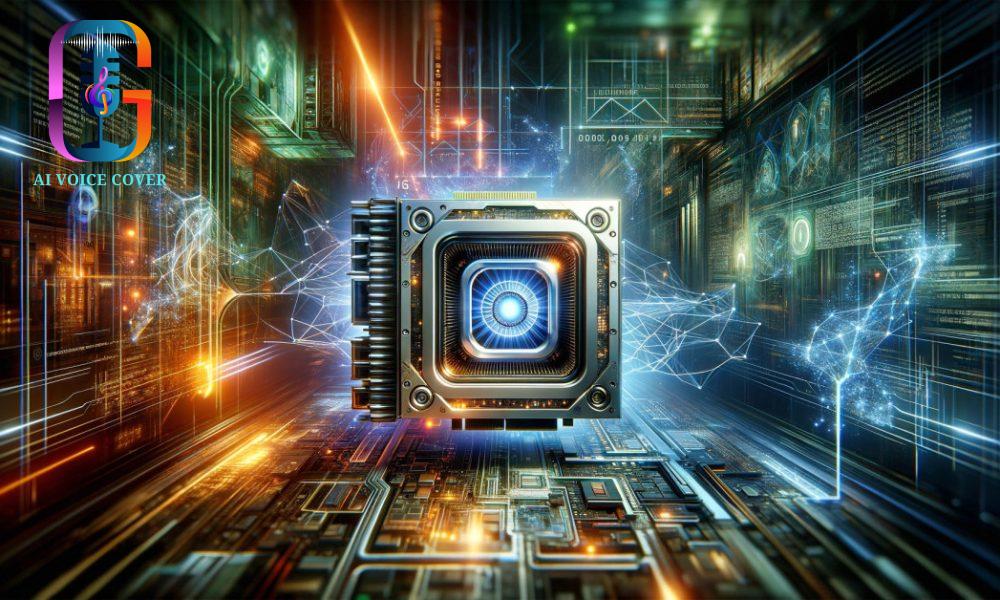

Image: Created with DALL-E
Nvidia has announced the H200 GPU, a significant advancement in artificial intelligence and computing. This groundbreaking graphical processing unit represents an upgrade from its precursor, the H100, which played a crucial role in training GPT-4, an advanced large language model developed by OpenAI. The debut of the H200 GPU is not only an evolution in technology but also a driving force in the thriving AI sector, meeting the increasing needs of corporations, startups, and government entities.
The arrival of the H200 comes at a time of unprecedented growth in AI capabilities, expanding the horizons of machine learning and AI. With its enhanced features and capabilities, the H200 is a testament to Nvidia’s commitment to pushing the boundaries of AI technology. Its impact extends beyond machine learning and AI, reshaping the landscape of computational power and efficiency in a dynamic digital world.
Delving into the specifics of the H200, its technical prowess, and the implications for the AI sector and broader tech community, it is evident that Nvidia is not only addressing current demands but also shaping the future of AI development.

Image: Nvidia
The Progression of Nvidia’s Graphics Processing Units
The transition from Nvidia’s H100 to the newly introduced H200 GPU signifies a story of relentless innovation and technological progress. The H100, a robust and potent GPU, has played a pivotal role in crucial AI advancements, including the training of the sophisticated large language model, GPT-4. This chip, estimated to cost between $25,000 and $40,000, has been integral in AI development across various sectors, driving the creation of models that require thousands of GPUs working collectively during the training phase.
However, the leap to the H200 represents a substantial upgrade in power, efficiency, and capabilities. The H200 is not merely an incremental improvement; it represents a transformative shift that amplifies the potential of AI models. A standout enhancement in the H200 is its 141GB of next-generation “HBM3” memory, designed to significantly enhance the chip’s performance in “inference” tasks. Inference, the phase where a trained model generates text, images, or predictions, is crucial for the practical application of AI, and the H200’s advancements directly cater to this need.
The significance of this advancement cannot be overstated. As AI models become more complex and data-intensive, the demand for more powerful and efficient GPUs has surged. The H200, with its enhanced memory and capability to generate output nearly twice as fast as the H100, as demonstrated in tests using Meta’s Llama 2 LLM, represents a critical step in meeting these escalating demands.
Furthermore, the arrival of the H200 has generated immense anticipation and enthusiasm within the tech and AI communities, as well as the broader market.

Image: Nvidia
Financial Implications and Market Reception
The launch of Nvidia’s H200 GPU has had a substantial impact on the company’s financial standing and market perception. This new development has propelled Nvidia’s stock, reflecting an increase of over 230% in 2023. This robust performance indicates the market’s confidence in Nvidia’s AI technology and its potential. The company’s fiscal projections for its third quarter, expecting around $16 billion in revenue—a staggering 170% increase from the previous year—underscore the financial implications of their advancements in AI GPUs.
This financial upturn is a direct result of the heightened interest and demand in the AI sector, especially for potent GPUs capable of handling advanced AI tasks. The price range of the H100 already positioned it as a high-value asset in the AI market. With its enhanced capabilities, the H200 is poised to further this trend, appealing to a wide range of customers from major tech firms to government agencies, all looking to harness the power of AI.
Furthermore, the introduction of the H200 GPU places Nvidia in a competitive position with other industry players, most notably AMD with its MI300X GPU. The competition transcends raw power or memory capacity, encompassing aspects like energy efficiency, cost-effectiveness, and adaptability to various AI tasks. Nvidia’s H200, with its upgraded features and compatibility with previous models, positions the company strongly in this competitive landscape.
This market enthusiasm for Nvidia’s AI GPUs is not merely a short-term response; it reflects a broader trend in the tech industry towards AI and machine learning. As companies and governments increasingly invest in AI technology, the demand for potent, efficient GPUs like the H200 is anticipated to grow, further solidifying Nvidia’s position in the market.


